THE PREP COUNTER
Which Kitchen Knife for Which Job: A Task-by-Task Guide
Which kitchen knife to use for dicing onions, peeling, bread, tomatoes, deboning chicken and carving roasts, with a table matching each knife to the job.
The short answer
Use a chef's knife or a santoku for most chopping, slicing and dicing. Use a paring knife for peeling and small work in your hand, and a serrated bread knife for crusty bread and soft-skinned tomatoes. Reach for a boning knife to take meat off the bone, and a long carving or slicing knife to cut cooked roasts into even slices.
This guide is for home cooks who own a few knives and are not sure which one to grab. A "kitchen knife job" here means any everyday prep task: dicing, peeling, slicing, trimming or carving. Match the blade shape to the task and the work gets easier and safer.
What does each common kitchen knife do?
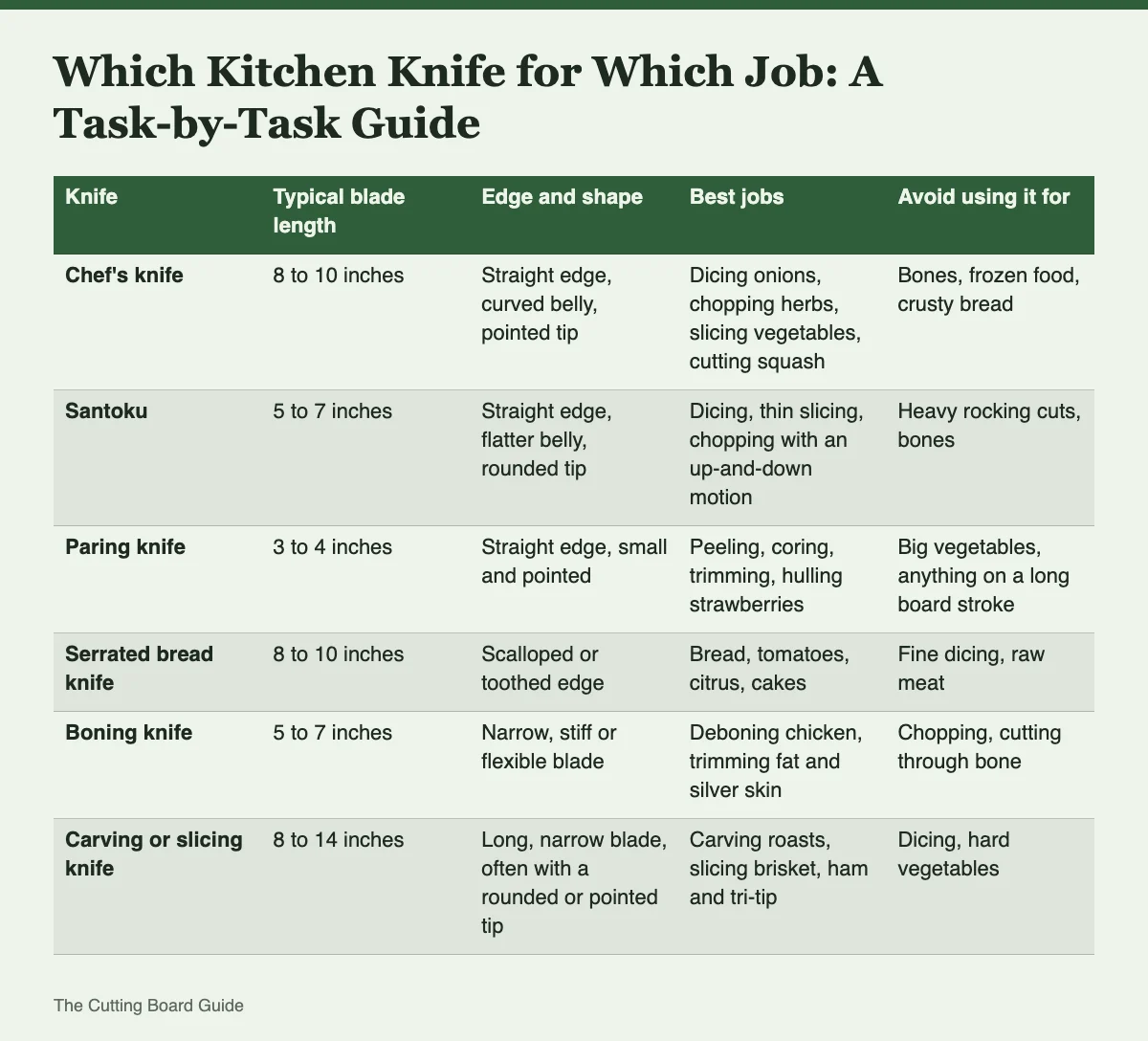
Each knife is defined by its blade length, its profile and its edge. A long, curved blade rocks. A short, pointed one works in your hand. A serrated edge saws through crust and skin.
| Knife | Typical blade length | Edge and shape | Best jobs | Avoid using it for |
|---|---|---|---|---|
| Chef's knife | 8 to 10 inches | Straight edge, curved belly, pointed tip | Dicing onions, chopping herbs, slicing vegetables, cutting squash | Bones, frozen food, crusty bread |
| Santoku | 5 to 7 inches | Straight edge, flatter belly, rounded tip | Dicing, thin slicing, chopping with an up-and-down motion | Heavy rocking cuts, bones |
| Paring knife | 3 to 4 inches | Straight edge, small and pointed | Peeling, coring, trimming, hulling strawberries | Big vegetables, anything on a long board stroke |
| Serrated bread knife | 8 to 10 inches | Scalloped or toothed edge | Bread, tomatoes, citrus, cakes | Fine dicing, raw meat |
| Boning knife | 5 to 7 inches | Narrow, stiff or flexible blade | Deboning chicken, trimming fat and silver skin | Chopping, cutting through bone |
| Carving or slicing knife | 8 to 14 inches | Long, narrow blade, often with a rounded or pointed tip | Carving roasts, slicing brisket, ham and tri-tip | Dicing, hard vegetables |
If you only buy three, most cooks are well served by a chef's knife (or santoku), a paring knife and a serrated bread knife. The boning and carving knives are worth adding if you cook a lot of meat.
Which knife should you use for dicing onions?
Use a chef's knife or a santoku. Both have enough blade length to cross a whole onion half in one stroke, and enough height to keep your knuckles off the board.
A chef's knife has a curved belly, so it suits a rocking motion: the tip stays down and the heel rises and falls. A santoku has a flatter edge, so it suits a straight up-and-down chop or a forward push cut. Neither is better in general. Pick the one that matches how you like to move.
Keep your guiding hand curled into a "claw," knuckles against the blade, so the knife meets knuckles, not fingertips.
Which knife is best for peeling and small trimming?
A paring knife. Its short blade gives you control when you hold the food in one hand and cut toward your thumb, the way you peel an apple or core a strawberry.
It also handles jobs a big blade makes awkward, like deveining shrimp or cutting the eyes out of a potato. For long peels on hard vegetables, a Y-peeler is often faster and safer.
Do not use a paring knife for big, dense vegetables. It is too short to get through them, and the extra force it takes is what causes slips.
What knife should you use for bread and tomatoes?
A serrated bread knife for both. The teeth grip and cut through a hard crust or a slick skin before the soft inside gets crushed.
With bread, sawing is the right motion. Let the teeth do the work and use long, light strokes rather than pressing down. With tomatoes, the serrations bite the skin right away, so the slice starts clean instead of squashing the tomato.
A very sharp chef's knife or paring knife will also slice a tomato cleanly. If your straight-edged knife slides off the skin, that is a sign it needs sharpening.
Which knife do you use to debone chicken?
A boning knife. Its narrow blade slips along bones and around joints, and its point lets you cut close to the bone without wasting meat.
Boning knives come in stiff and flexible versions. A stiffer blade is good for chicken and pork, where you push through joints and cartilage. A more flexible blade bends around curves and suits fish (where it is often sold as a fillet knife).
Cut through cartilage and joints, not through bone. Neither a boning knife nor a chef's knife is made to cut bone. A cleaver or poultry shears handle that.
Raw poultry needs care. Use a separate board for it, and wash the knife and board in hot, soapy water before they touch anything else, as the FoodSafety.gov four steps advise.
What knife is best for carving roasts?
A long carving or slicing knife. A blade of 10 inches or more lets you cut each slice in one or two long strokes, so the slices come out even and the crust stays on.
Carving knives are usually pointed, which helps around the bones of a chicken or turkey. Slicing knives are often longer with a rounded tip, and some have shallow dimples (a "granton edge") that reduce sticking.
For a whole bird, this guide to the best cutting board for carving meat covers the setup you need around the knife. For a roast with tricky grain, see how to slice tri-tip against the grain. Before carving poultry, make sure it has reached 165°F, the safe minimum on the USDA safe temperature chart.
Which knife should you use for hard vegetables like squash?
A sharp 8- to 10-inch chef's knife. You need a long, sturdy blade to get through the dense flesh, and a stable, flat-sided piece of squash to cut.
This is not a job for a paring knife or a santoku with a thin blade, and never for a serrated bread knife. Trim the ends first so the squash sits flat. Our step-by-step guide to cutting a butternut squash safely walks through every cut.
Should you choose a chef's knife or a santoku?
Choose whichever fits your hand and cutting style. The chef's knife is longer and rocks well. The santoku is shorter, lighter and flatter, and it chops cleanly with an up-and-down motion.
If you can, hold both before you decide.
How much should you spend on kitchen knives?
You do not need an expensive set to cook well. Stamped knives from established makers such as Victorinox and Mercer are low in cost and widely used. Premium knives from makers like Wüsthof, Zwilling, Global, MAC, Tojiro and Shun cost more and often hold an edge longer, depending on the steel. Some are forged and heavier, while others, like most Global and MAC knives, are lighter.
Large block sets often include knives you will rarely use. Buying only the few you need is usually better value.
What are the most common knife mistakes?
- Using a dull knife. It needs more force, and force is what makes knives slip.
- Using the wrong size. A paring knife on a squash or a chef's knife on a strawberry makes the job harder.
- Cutting bone with a chef's or boning knife. It can chip or roll the edge.
- Scraping food off the board with the edge. Flip the knife and use the spine instead.
- Leaving knives loose in a drawer. Use a block, a magnetic strip or blade guards.
- Putting good knives in the dishwasher. Most makers recommend hand washing and drying right away.
What should you do after choosing your knives?
Keep them sharp, keep them dry and store them safely. A honing steel realigns the edge between sharpenings. It does not remove much metal, so you still need to sharpen when honing stops helping.
Sharpen straight edges on a whetstone, a pull-through sharpener or through a sharpening service. Serrated knives need a tapered rod or a professional.
Cut on a wood or plastic board. Glass, stone and ceramic surfaces dull edges quickly.
Best for
- Chef's knife: dicing onions, chopping herbs, slicing vegetables and cutting hard squash.
- Santoku: cooks who chop with an up-and-down motion or prefer a shorter, lighter blade.
- Paring knife: peeling, coring, trimming and any work done in your hand.
- Serrated bread knife: crusty bread, tomatoes, citrus and soft cakes.
- Boning knife: deboning chicken and trimming fat or silver skin.
- Carving or slicing knife: roast chicken, turkey, tri-tip, brisket and ham.
Frequently Asked Questions
What is the one knife every kitchen should have?
A chef's knife, or a santoku if you prefer a shorter blade. It handles most everyday chopping, slicing and dicing.
What knife is best for cutting tomatoes?
A serrated knife grips the skin and slices without crushing the tomato. A very sharp chef's or paring knife also works well.
Can you use a chef's knife to debone chicken?
You can, but a boning knife is easier. Its narrow, pointed blade follows bones and joints more closely and wastes less meat.
What is the difference between a carving knife and a slicing knife?
A carving knife is usually narrower and pointed, which helps around bones. A slicing knife is often longer with a rounded tip, made for even slices of boneless roasts.
Do serrated knives need sharpening?
Yes, but far less often than straight edges. They need a tapered sharpening rod or a professional service rather than a flat stone.
What should you do next?
- Check which of the six knives above you already own, and note which tasks you are doing with the wrong one.
- Hone your chef's knife and test it on a tomato. If it slides off the skin, sharpen it.
- Practice the claw grip on an onion with your chef's knife or santoku.
- Use a long slicing knife on your next roast, following how to slice tri-tip against the grain or the guide to the best cutting board for carving meat.
- Try your chef's knife on a dense vegetable with how to cut a butternut squash safely.
How this guide was put together
The Cutting Board Guide team writes and fact-checks every guide on The Cutting Board Guide. Comparisons are based on maker specifications, published standards and food-safety guidance from sources such as the USDA, and each guide is reviewed and updated when specs or prices change. More about us.