THE PREP COUNTER
How to Cut a Mango: 3 Easy Methods With Less Mess
How to cut a mango into cubes, slices, or spears. Find the pit, choose the right knife, and keep the cutting board from turning into a sticky mess.
The short answer
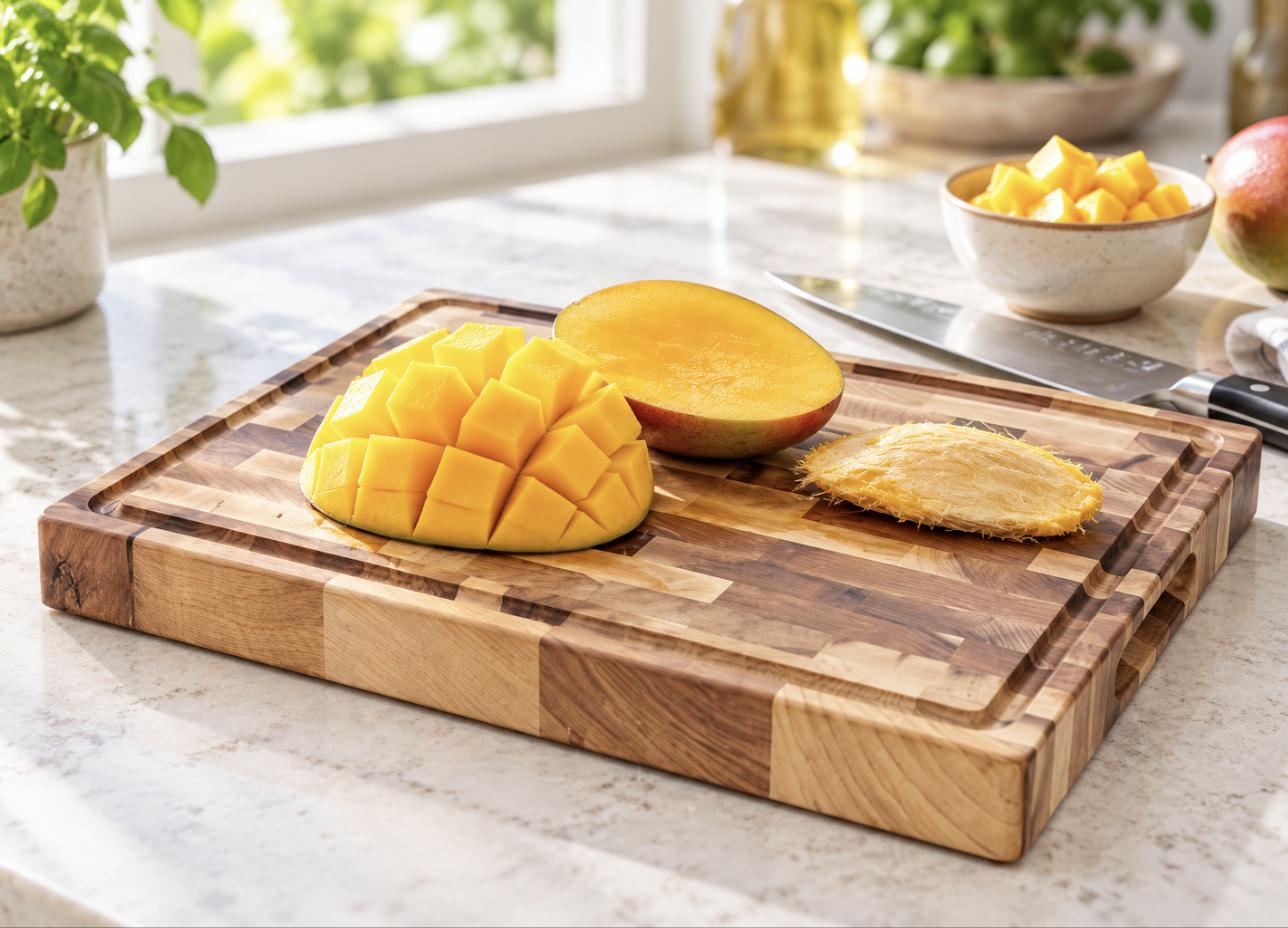
To cut a mango, stand it on its stem end and slice down about a quarter inch to each side of the center to remove the two "cheeks." The flat, oval pit runs through the middle, so cutting just off-center lets you miss it. Then score each cheek into a grid, push the skin to turn it inside out, and slice off the cubes.
That is the cheek method, and it works for most mangoes. Below are three methods, how to tell if a mango is ripe, and how to keep the juice under control.
What do you need to cut a mango?
- A sharp chef's knife or paring knife. A dull blade crushes ripe mango instead of slicing it.
- A stable cutting board. Mango juice is slippery, so the board should not move. A damp towel underneath helps; see our fixes for keeping a maple cutting board from slipping.
- A large spoon or a drinking glass for the scoop method.
- A bowl to collect the fruit as you go.
Wash the outside of the mango before cutting. Your knife will drag anything on the skin across the flesh.
How do you find the pit?
A mango pit is wide and flat, like a large almond, and it runs from the stem to the bottom. Stand the mango upright on its stem end. Look at it from above: it is usually slightly oval. The pit sits along the long axis of that oval, so the wide, flat "cheeks" are on either side of the narrow part.
If your knife hits something hard, the pit is there. Move the blade slightly outward and try again.
Method 1: The cheek and grid method (for cubes)
This is the fastest way to get even cubes for salsa, salads, or smoothies.
- Stand the mango on its stem end on the board.
- Slice straight down about ¼ inch to one side of center to cut off the first cheek. Repeat on the other side.
- Hold a cheek skin-side down in your palm or flat on the board. Score the flesh in a crosshatch pattern, cutting down to the skin but not through it.
- Press the skin from underneath so the cubes pop outward.
- Slice the cubes off close to the skin, or scrape them into a bowl with a spoon.
- Trim the remaining flesh off the narrow sides of the pit.
If you are new to knife work, score the cheek flat on the board instead of in your hand. It is slower, but your palm stays out of the way of the blade.
Method 2: The glass or spoon method (for scooping)
- Cut off both cheeks as above.
- Hold a cheek and press the edge of a sturdy drinking glass against the point where flesh meets skin.
- Slide the glass down so the flesh peels away into the glass in one piece.
- Slice or dice the flesh on the board.
This works best on ripe mangoes. Very soft fruit can tear.
Method 3: Peel first (for slices and spears)
- Peel the mango with a vegetable peeler or a paring knife, like you would an apple.
- Stand it on its end and cut off the cheeks.
- Lay each cheek flat and slice into strips or spears.
Peeled mango is very slippery, so go slowly. A grippy board surface helps more here than with the other methods.
Which method should you use?
| Method | Best for | Difficulty | Mess level |
|---|---|---|---|
| Cheek and grid | Cubes for salsa, salads, smoothies | Easy | Low |
| Glass or spoon | Whole halves, quick scooping | Easy | Low |
| Peel first | Neat slices, spears, plating | Moderate | High |
How can you tell if a mango is ripe?
Color is not a reliable sign. Many varieties stay green when ripe. The National Mango Board recommends judging by feel: a ripe mango gives slightly when you squeeze it gently, like a ripe peach or avocado. A fruity smell near the stem is another good sign.
If your mango is hard, leave it on the counter at room temperature for a few days. Once it is ripe, move it to the refrigerator to slow further ripening.
How do you keep your cutting board clean after mango?
Mango juice is sticky and its sugars can leave a tacky film on a wood board. Rinse the board with warm water and a little dish soap soon after cutting, then dry it on edge. Do not let juice sit for hours. If you notice a lingering fruity smell, our guide on getting the smell out of a maple cutting board covers simple fixes.
Some people get an itchy rash from mango skin, because the skin and sap contain urushiol, the same compound found in poison ivy. If that happens to you, wear gloves when handling whole mangoes, or ask someone else to peel them.
Before you start
- Cost and yield: A mango usually costs about $1 to $3. A large mango gives roughly 1 to 1.5 cups of cubed fruit once the skin and the flat seed are removed.
- Time: About 2 to 3 minutes per mango with a chef's or paring knife once you know where the seed sits.
- Alternatives: A mango splitter (about $10 to $20) cuts both cheeks off the seed in one push but leaves more fruit behind. Frozen mango chunks skip the knife work entirely for smoothies.
- Common mistakes: Cutting straight down the center into the flat seed, cutting an unripe mango that resists the knife and slips, letting the slick fruit slide on a wet board, and handling a lot of mango skin if you react to poison ivy (the skin contains urushiol, the same irritant).
- Food safety: Rinse the mango before cutting so the knife does not carry anything from the skin into the flesh, and use a clean board.
Sources: USDA FSIS: Cutting Boards and Food Safety.
Best for
- Cheek and grid: even cubes for salsa, salads and smoothies.
- Glass or spoon: quick scooping of ripe mango cheeks.
- Peel first: neat slices and spears for plating.
- Scoring on the board, not in your hand: anyone new to knife work.
Frequently Asked Questions
What is the easiest way to cut a mango?
The cheek and grid method is the easiest. Cut the two cheeks off either side of the pit, score them in a crosshatch, turn them inside out, and slice off the cubes.
Do you peel a mango before cutting it?
You do not have to. The cheek and glass methods remove the skin after cutting, which is less slippery and less messy than peeling first.
Can you eat mango skin?
Mango skin is edible but tough and bitter, and it can irritate people sensitive to urushiol. Most people remove it.
How do you cut a mango without a knife?
You still need a knife to remove the cheeks, but after that you can scoop the flesh out with a large spoon or the rim of a glass.
How long does cut mango last in the fridge?
Cut mango keeps for about three to five days in an airtight container in the refrigerator.
What should you do next?
- Press the mango gently to check that it gives a little before you cut.
- Wash the skin, then set your board on a damp towel.
- Start with the cheek and grid method, then try the other two.
- Rinse the board with warm soapy water soon after, towel-dry it, and stand it on edge.
- For more juicy-fruit prep, see why cooks like maple cutting boards for fruits and vegetables.
How this guide was put together
The Cutting Board Guide team writes and fact-checks every guide on The Cutting Board Guide. Comparisons are based on maker specifications, published standards and food-safety guidance from sources such as the USDA, and each guide is reviewed and updated when specs or prices change. More about us.